Call

 Send Email
 Messenger
 WhatsApp

Can sellers ask for any price for their property in Bulgaria?
 In recent years, strong competition among buyers and continuously rising property prices created the impression that almost any property could be sold at a high price. Owners often based their asking prices on the highest listings in their neighbourhood, adding an expectation of further price increases. In a market characterised by strong demand, this strategy frequently proved successful.
Today, however, the situation is different. Buyers still have access to bank financing, but with property prices having reached their current levels, they are becoming increasingly careful about what they receive for their money. As demand becomes more selective, the gap between the price a seller expects and the amount a buyer is prepared to pay is becoming increasingly important.
Property Prices Continue to Rise, but Growth Is Slowing
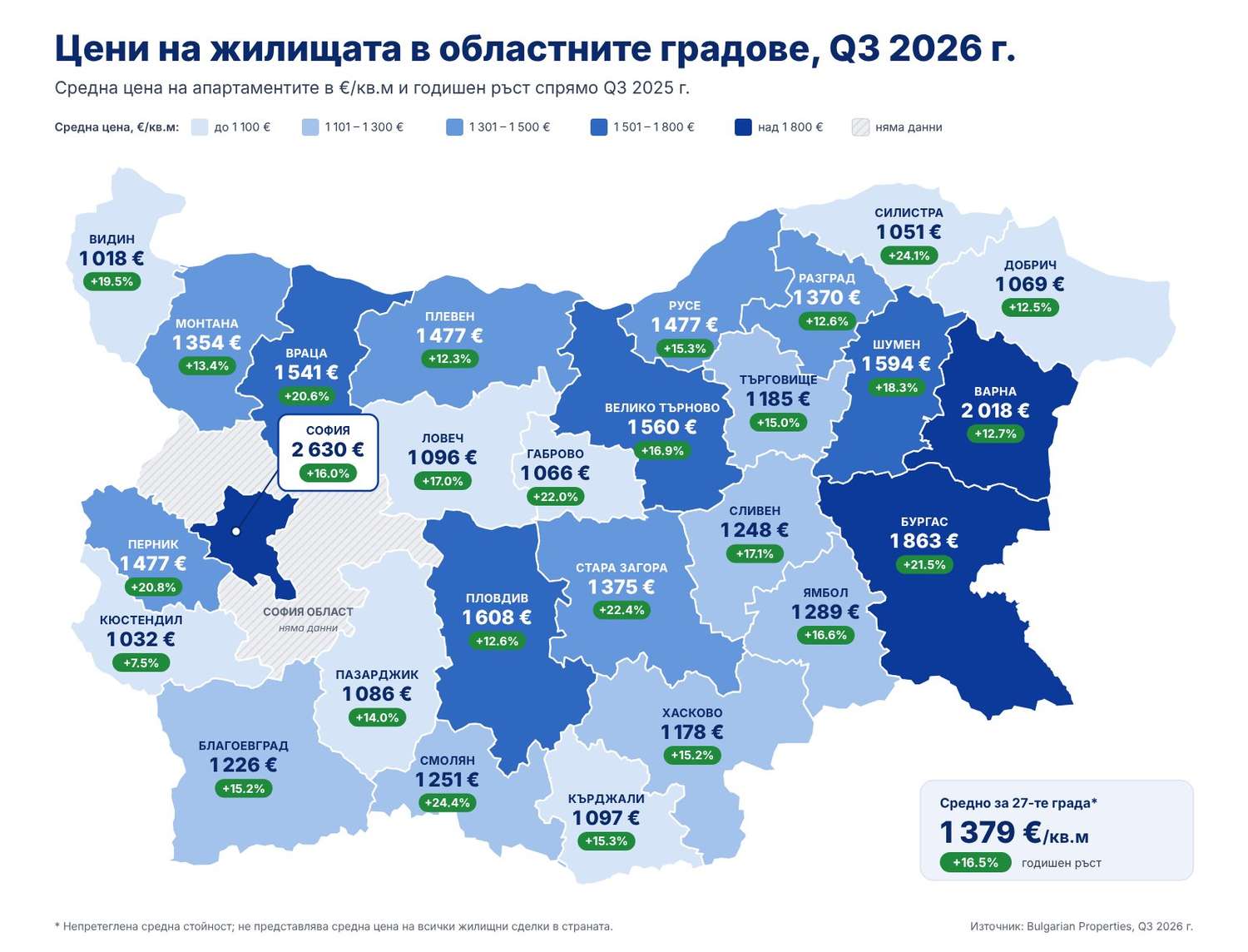
The latest BULGARIAN PROPERTIES data for the third quarter of 2026 show that residential property prices continue to increase, although quarterly growth has become more moderate in most major cities.
In Sofia, the average apartment price has reached ˆ2,630 per sq.m, representing an increase of 16% compared with a year earlier, while quarterly growth stands at just 2%.
A similar trend can be observed in Varna, where the average price has reached ˆ2,018 per sq.m, reflecting annual growth of 12.7% and a quarterly increase of 1.6%. In Plovdiv, prices average ˆ1,608 per sq.m, up 12.6% year-on-year but only 2% compared with the previous quarter.
The property market in Burgas remains more dynamic. Average prices have reached ˆ1,863 per sq.m, representing increases of 21.5% year-on-year and 4.7% quarter-on-quarter.
Differences between individual markets remain significant. Annual price growth has reached 22.4% in Stara Zagora, 15.3% in Ruse and 16.9% in Veliko Tarnovo.
These figures indicate that the market continues to move upwards, but not at the same pace everywhere. In a number of cities, price increases over the past three months have been relatively modest, while annual figures still reflect the cumulative growth recorded in previous quarters.
It is important to distinguish between slowing price growth and an actual decline in prices. For now, BULGARIAN PROPERTIES data do not indicate widespread price reductions, but rather a gradual moderation in market dynamics in certain locations.

Property Transactions Are Declining While Prices Continue to Rise
An even clearer indication of the changing market comes from transaction statistics.
According to Bulgaria's Registry Agency, 45,312 property sales were registered nationwide in the third quarter of 2026, compared with 58,184 during the same period a year earlier. This represents a year-on-year decline of more than 22%.
The decrease is also evident in the country's main urban property markets. Registered sales fell by 21.2% in Sofia, 23.9% in Plovdiv, 26.3% in Varna and 14.3% in Burgas.
Importantly, transaction volumes are lower not only compared with the exceptionally strong year of 2025. In the third quarter of 2024, 54,138 property sales were registered nationwide, while the corresponding figure for the pre-pandemic year of 2019 was 55,103. Current transaction volumes are approximately 16.3% and 17.8% lower, respectively.
The divergence between rising property prices and falling transaction volumes is one of the defining characteristics of Bulgaria's property market in 2026.
This may signal a widening gap between buyers' and sellers' price expectations. Some property owners continue to base their expectations on prices achieved during periods of particularly strong demand, while buyers are now taking a more cautious approach to purchasing decisions.
A decline in transactions does not necessarily mean that demand has fallen by the same percentage. It may also reflect differences in price expectations, a limited supply of suitable properties or decisions to postpone purchases.
Nevertheless, it demonstrates that successfully completing a property sale is becoming more challenging.
Buyers Are No Longer Willing to Make the Same Compromises
During the years of strong market growth, rapidly rising prices often created an additional incentive to buy.
The fear that the same property might cost considerably more just a few months later could accelerate purchasing decisions and reduce buyers' willingness to engage in lengthy negotiations.
This psychological factor is now becoming less influential.
With property prices having reached relatively high levels, and buying a home requiring a substantial financial commitment, purchasers have increasingly good reasons to compare different properties carefully.
Simply being located in a desirable neighbourhood is no longer enough.
The quality of the building, practicality of the layout, condition of the property, local infrastructure, parking facilities, energy efficiency and any additional expenditure required after purchase all play an important role.
This is also changing how the market values individual properties.
Two apartments of identical size, located just a few streets apart, may have significantly different market values.
One may meet almost all buyers' requirements and sell relatively quickly. The other, despite having a similar asking price, may remain on the market for considerably longer because of compromises relating to its location, layout, construction quality or the additional investment required.
When market activity weakens, these differences become even more apparent.
The total cost of acquiring a property, rather than simply the advertised price, is also becoming increasingly important.
An apartment requiring extensive renovation may appear attractive in terms of price per square metre. However, once the necessary additional expenditure is taken into account, it may prove less cost-effective than a more expensive property in good condition.
As a result, competition is gradually shifting away from buyers bidding against one another towards sellers competing for the attention of a smaller pool of purchasers who are genuinely ready to proceed with a transaction.
Sellers Are Beginning to Adjust to Market Conditions
Changes in market sentiment rarely occur simultaneously on both sides of a property transaction.
Owners generally base their expectations on previously achieved price levels, asking prices for neighbouring properties and information about transactions completed in recent months.
After a prolonged period of rising prices, it is natural for their expectations to remain high, even when market activity begins to decline.
This is where the distinction between an asking price and a property's market value becomes particularly important.
The advertised price indicates how much an owner would like to receive. The actual market value, however, depends on what a buyer is prepared to pay under the prevailing conditions and what alternative properties are available.
When demand is strong, the difference between these figures may remain relatively small.
In a more selective market, the gap can widen, particularly when a property's asking price does not accurately reflect its characteristics.
This does not mean that all sellers will have to reduce their prices.
Rather, the market is beginning to distinguish more clearly between competitively priced properties and those where sellers' expectations exceed what buyers are realistically prepared to pay.
For owners who are in no hurry to sell, maintaining a high asking price may remain an acceptable strategy. However, for those wishing to complete a transaction within a specific timeframe, setting the right price from the outset is becoming increasingly important.
The period when general market appreciation could compensate for almost any weakness in an individual property is gradually giving way to a market in which quality, specific property characteristics and realistic pricing play a decisive role.
For sellers, this means that simply knowing how much properties cost in their neighbourhood is no longer sufficient.
What matters is understanding how much the market is genuinely prepared to pay for their particular property, and how long it may take to find the right buyer.

Read more news
More News

Extensive work on the foundations and underground levels has laid the groundwork for two 75-metre towers that will bring together distinctive architecture, panoramic homes and a premium living environment in Sofia.
Ten months after construction began, Sky Towers by AMur is starting to rise above ground. This visible progress follows substantial work below the surface, ...

🍂 The Bulgarian property market has found its new balance and continues to move forward!
October was a busy, active and productive month for BULGARIAN PROPERTIES. We successfully completed numerous property transactions, while renewed market activity gave us encouraging signals for the final quarter of the year.
Almost a year after Bulgaria adopted the euro, t...
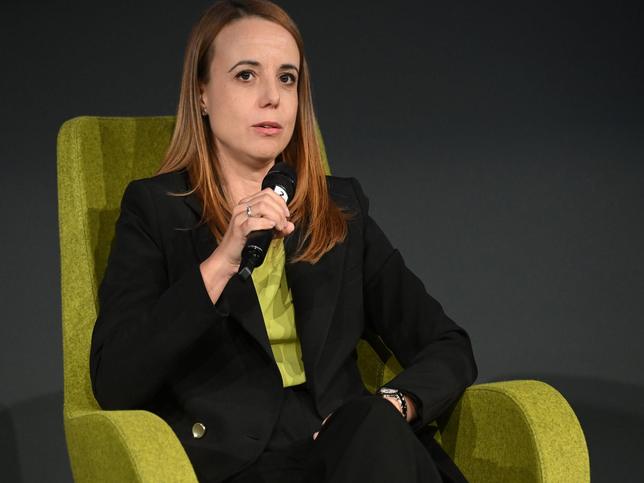
Polina Stoykova MRICS discusses buyer behaviour, successful property sales and the outlook for the sector
BULGARIAN PROPERTIES took part as a partner in the Real Estate Business Forum, organised by Imoti.net on 20 October 2026 at Inter Expo Center in Sofia. The forum focused on changes in the property market, prices and transactions, new developments, mortgage lending, and the role ...
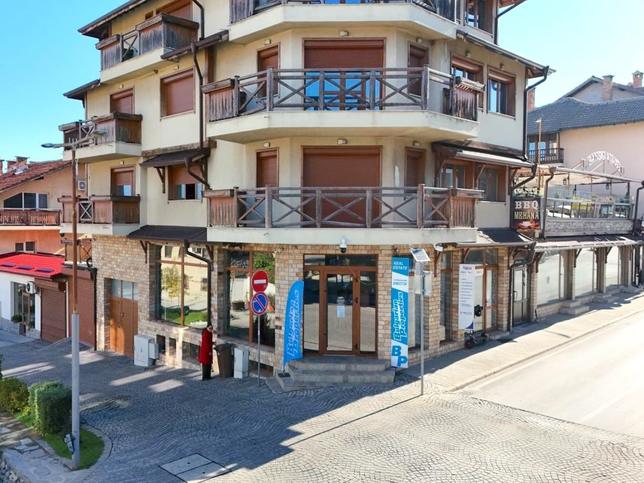
A new season, a new address and the same dedicated team! BULGARIAN PROPERTIES now welcomes clients and partners at its new office at 5, Gotse Delchev Street, Bansko.
As the winter season approaches, we invite anyone considering buying or selling a property in the area to visit us. Whether you are looking for a cosy ski apartment, a permanent home in the mountains or an investment pr...