
 Call
Call

 Send Email
 Messenger
 WhatsApp

Varna Featured in a Financial Times Article
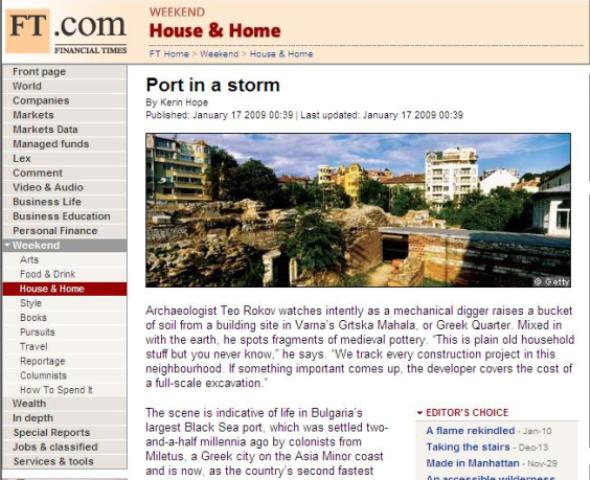 Archaeologist Teo Rokov watches intently as a mechanical digger raises a bucket of soil from a building site in Varna’s Grtska Mahala, or Greek Quarter. Mixed in with the earth, he spots fragments of medieval pottery. “This is plain old household stuff but you never know,” he says. “We track every construction project in this neighbourhood. If something important comes up, the developer covers the cost of a full-scale excavation.”
The scene is indicative of life in Bulgaria’s largest Black Sea port, which was settled two-and-a-half millennia ago by colonists from Miletus, a Greek city on the Asia Minor coast and is now, as the country’s second fastest growing city, coping with a big influx of new residents.
Originally, and for centuries under Greek, Roman and Turkish rule, Varna was a hub for traders shipping salted fish, grain, furs and gold to the Mediterranean and beyond. By the early 1900s Armenians, Jews and Bulgarians had joined Greek merchants and many took part in a grand urban revival of the city, launched by King Ferdinand. New mansions designed by Italian architects were painted in pastel colours appropriate to a fashionable European resort with a pier, wooden bathing huts and a Sea Garden (a stretch of parkland planted with rare trees under the supervision of a renowned Czech botanist and landscaper).
Communism followed and, after that, a gritty transition period, including shootings of local mobsters in crowded seaside cafés. But, according to residents, a group of ex-Bulgarian marines nicknamed the “Varna Seals” eventually managed to expel members of the Russian, Chechen, Ukrainian and Georgian mafias vying for control of the port and the city’s underground economy. And today “you can stroll around the centre late at night without problems,” says Agap Agapov, a restaurant owner in Grtska Mahala.
Varna now draws about 30,000 new residents a year and it was recently rated Bulgaria’s “best city to live in” for the second year running in a poll carried out by Darik Radio, a private station, and 24 Chasa, a national newspaper. Students from three local universities support a lively bar and music scene and, in summer, the city’s seafront promenade fills up with visitors from the capital, Sofia, western European tourists bussed in from nearby resorts for a day’s sightseeing and increasing numbers of Russians, Ukrainians and Romanians, whose own Black Sea coastlines are less hospitable than Bulgaria’s.
The country has been hit by energy shortages this month following Russia’s cut-off of gas supplies to Europe. But the Bulgarian government has now asked the European Union for €400m to build a link with an alternative Turkish-Greek pipeline and Varna itself plans to consider the possibility of building a liquefied natural gas terminal.
Transport links to the city have already been improving, with gradual upgrades to the highway to Sofia, a five-hour drive away, and more frequent air connections via Bulgaria Air, which runs three flights daily to the capital in winter and four in summer. Fraport, a German company, is now running the city airport under a 35-year concession, investing in a runway refurbishment and expanded terminal facilities, and several international airlines, including low-cost operators, now fly to Varna from European hubs.
For now, the Greek Quarter remains one of the most attractive areas to live, with some of the city’s highest property prices, ranging from €2,200 per sq metre for an apartment in a communist-era four-storey block (the maximum height permitted) to €3,000 per sq metre for one in a renovated mansion or a new building with a view of the sea.
Living spaces tend to be compact, with studios running to 50-60 sq metres including the balcony, and 100-120 sq metre apartments deemed a comfortable size for four-member families. Many dilapidated buildings still await refurbishment but the quarter is beloved both by old-timers, such as Agapov, who serves fresh fish from the ground floor of his family home in a space once occupied by his grandfather’s tailoring workshop, as well as new arrivals, such as diving instructor Iasen Ivanchev, who will soon move into an attic apartment one block from the seafront.
But there are downsides to living in the Grtska Mahala, including increased traffic, more street noise than in the suburbs and a shortage of parking spaces, with only a handful of new, high-end buildings having underground garages. “When I was growing up here, we played street games all the time. It wasn’t quite the same for my daughter,” says Darina Ivanova, a colleague of Ivanchev, who moved to the neighbourhood as a child.
The area has developed so fast that it will be another year before access roads and street lighting are completed. But prices for a top-floor apartment with a sea view have doubled in the past two years to about €1,600-2,200 per sq metre and are expected to rise marginally this year in spite of the global economic crisis. “We expect some homeowners in Briz will want to cash in their profits this year, so there’ll be opportunities to buy on the secondary market,” says Evgeni Zlatev, Varna office manager for estate agency Bulgarian Properties.
Read the whole article
Read more about Varna and the real estate market
View our offers in Varna
Read more news
More News

Summer is here, and the real estate market in Bulgaria continues to offer great opportunities for those who are well-informed and act at the right time!
May was a month of in-depth analyses and valuable market data, showing that the market is entering a more balanced phase. Buyers are becoming more cautious, supply is gradually increasing, and successful transactions increasingly d...
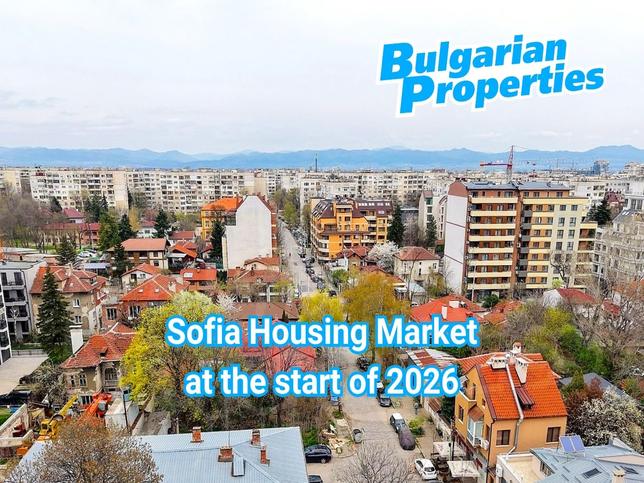
After two years of exceptionally strong price growth, limited supply and euphoria fuelled by the expected introduction of the euro, Sofia’s residential property market entered a new cycle in the first quarter of 2026.
The period was characterised by existing demand, but also by more moderate activity, as buyers and sellers reassessed their behaviour.
The market began ...
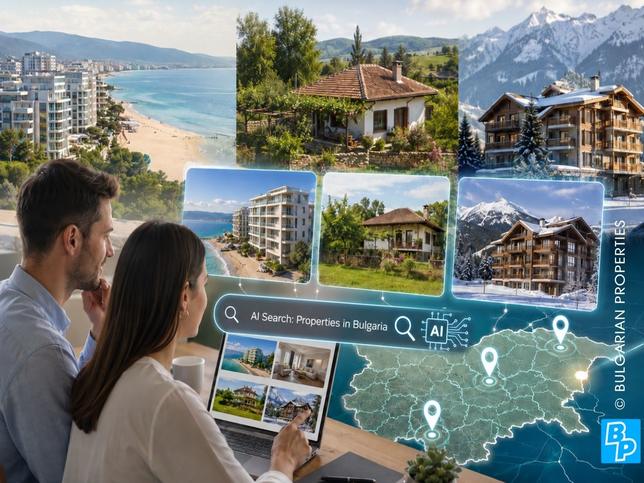
The first quarter of 2026 marks the beginning of a new stage in the development of Bulgaria’s property market, which is moving from a period of accelerated transactions in 2024–2025 into a phase of normalization, characterized by more mature and rational buyer behavior.
This shift is also visible in an analysis of nearly 15,000 real searches made between January and Ma...
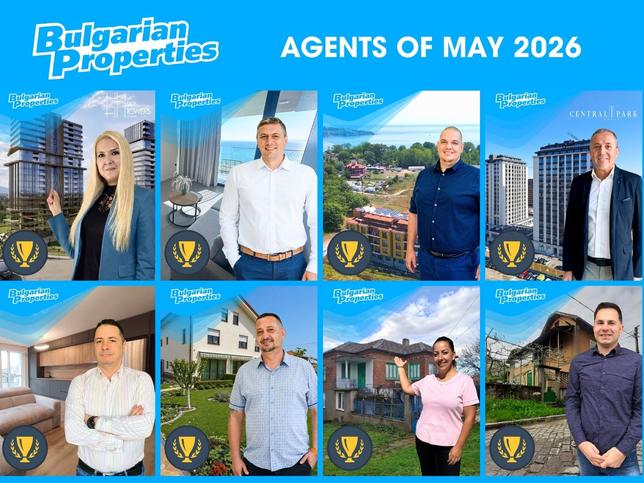
The market is rebalancing – and great results come with the right strategy!
April brought clear signals of a new phase in the real estate market in Bulgaria – a more moderate pace, more cautious buyers, and increasing supply. And yet, deals are happening across all segments when properties are positioned correctly.
In this more mature and competitive environment, our Agents ...