
 Call
Call

 Send Email
 Messenger
 WhatsApp

Great Turnovo
Veliko Turnovo is the Shangri La of Bulgaria. Clustered on hills – its houses like red-roofed barnacles – and divided by serpentine rivers, the city is a haven both for Bulgarians seeking to reclaim their past and expats seeking to escape theirs. It is, without a doubt, the country’s most beautiful town.
Veliko means ‘great,’ a namesake we realised was apt as we walked down a rock and wood staircase alongside the hillside of the Old Town. It was twilight. We had just finished catching up over coffee and cocktails. Below us was the River Yantra, its unkempt banks exploding with trees and shrubs. On the opposite side of the river we had a view of an enormous, Soviet-inspired monument to Bulgaria’s tsars, a memorial featuring a two-story high sword (yes, a big sword) and four bellicose horsemen.
Above us was the panorama of the city. Visitors to Bulgaria remark on its beautiful beaches and ski slopes, but rarely does one speak of anywhere in this former Ottoman colony in the same terms as, say, the Tiergarten in Berlin or Trafalgar Square in London. Those sites radiate power, history, culture. In short, greatness. Veliko Turnovo is the only place in Bulgaria where we’ve come across that feeling. Even if it was primarily in the form of nostalgia, we basked in it.
At the moment around 200 Brits have bought homes around Veliko Tarnovo. One might say the town is becoming a colony of a new sort. The British presence there has grown to the point that, on our visit, a reporter from The Mail on Sunday, one of the United Kingdom’s stuffiest newspapers, interviewed our pal about his plans to sell his apartment in order to underwrite the bar he was establishing.
Dressed in Oxford Street clothes, addressing us formally and conducting himself in an upright, respectable, businesslike way, the reporter seemed totally out of place.
Visitors without a friend’s apartment might want to stay at the Hotel Gurko at 33 General Gurko Street, a beautiful small hotel overlooking the panoramic scene described above. In the winter months, a single room costs around 40 leva. Now a double room costs 50 euro. Judging by its attractive lobby and restaurant, which in late May was too packed for us to enjoy a seat, the price is worth it.
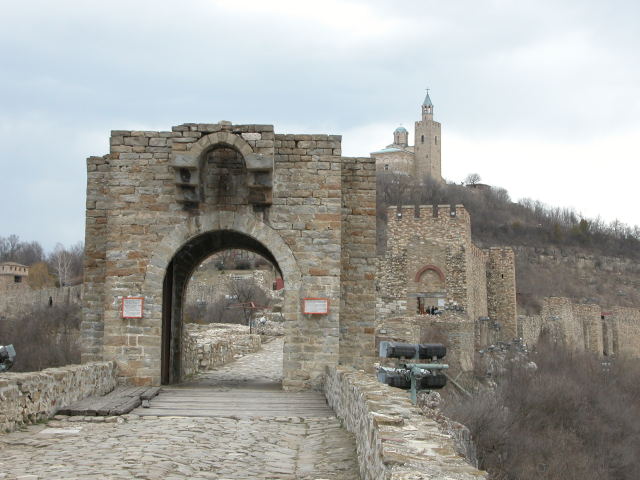
The town of Veliko Tarnovo was the capital of Bulgaria’s Second Kingdom until the Turks captured it in the late 14th century. To this day, Bulgarians harken back to the Second Kingdom as proof that their nation produced one of the first fully-fledged states in Europe. Tsarevets, the citadel and medieval capitol complex at the far east end of the town, is a destination for patriotic Bulgarians and busloads of fractious Bulgarian schoolchildren.
Our experience at Tsarevets was peculiar. As we stood overlooking the east end of town, tourists milling around us, the muezzin of a mosque down in the valley began his call to prayer. The song poured over us. Silk Bulgarian tri-colours flapped on the ramparts as the Muslim call to prayer rang for kilometres.
Food and drink in Veliko Turnovo was just OK. There are so many choices catering to visitors, one can be sure to avoid low quality food. But, of course, in exchange for that security, you give up finding something special, at least in the Old Town. Vinarnata on Stefan Stambolov Street – the towns’s main drag – offered tasty, if typical, Bulgarian fare. We ate a meal of lamb and rice there at a cost of slightly more than 10 leva. While it’s wonderful to eat outside, the restaurant’s dining room features an amazing view of the river.
At night we dropped in on Tequila, a bar on Stambolov Str. that featured electronic music and a young, dance-inclined crowd. It wasn’t a huge group, even on Saturday night, but we spoke to plenty of folks there.
Some were from the city’s university and art school, a hip bunch who were open to chat with us. Others were drunken Australians staying at a hostel. They were all about chatting.
One might want to walk west along Stambolov, until the street turns into Nezavisimost and then splits into Vasil Levski Boulevard and Hristo Botev Street, to find more restaurants and cafes off the beaten path.
We failed to visit the picturesque village of Arbanasi, the city’s Varosh quarter, the museum near the monument with the enormous sword, the monasteries in the area, the old, historic houses, the other bars, the dance clubs and the city’s other restaurants, as we cooked one of the two nights we were there.
We’ll be returning, in other words. Many times.
Purchase properties in/near Veliko Tarnovo
read more articles